



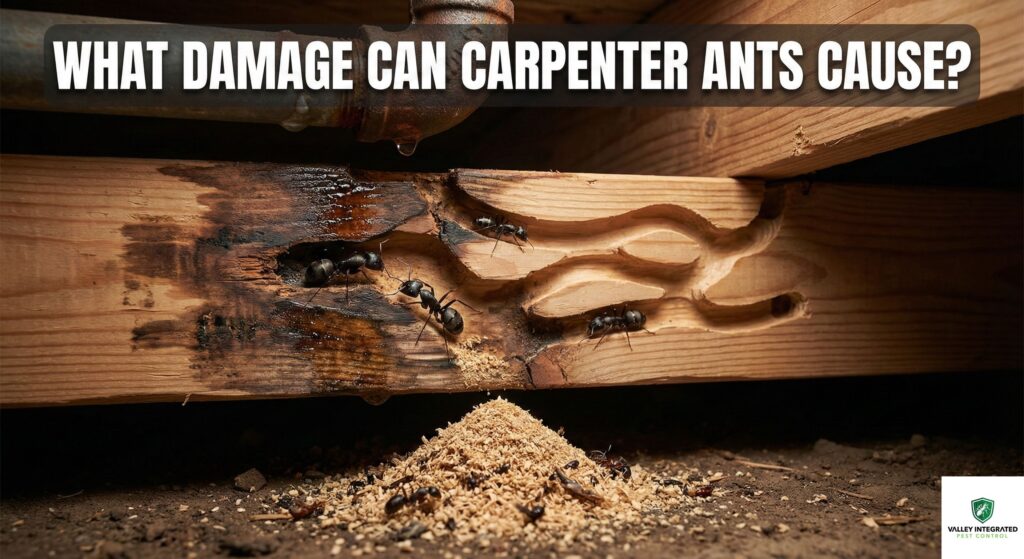
The damage carpenter ants cause is serious, but not for the reason most people think. They don’t eat wood like termites do. Instead, the real danger is what their presence signals: a hidden, pre-existing moisture problem that is actively rotting your home’s structural components from the inside out. Ignoring them allows this underlying decay to worsen, leading to far more extensive and costly repairs down the road.
The real danger hiding in your walls: more than just bugs
When you see a large, black ant in your house, it’s easy to focus on the bug itself. But a carpenter ant is more than just a pest; it’s an inspector. Think of them as nature’s moisture-detection experts. Their entire survival strategy is built around finding soft, damp, compromised wood to excavate for their nests. Carpenter ants ‘prefer wood with a very high moisture content,’ and when they nest in homes, ‘they are typically found in areas where there is a significant moisture problem,’ according to building experts. This is the first critical clue. The ants carpenter their way into wood not because they are primary destroyers, but because your home offered them an inviting, water-damaged environment to begin with.
Answering the question, “how serious is a carpenter ant problem?” requires shifting your focus from the ant to the environment that attracts carpenter ants. A few ants might just be foraging for food, but a persistent trail or evidence of nesting points to a much deeper issue within your home’s structure. The ant infestation is a symptom of a disease—the disease being water intrusion and wood rot.
Identifying the evidence: carpenter ant damage vs. termite damage
Understanding the kind of damage you’re seeing is a key factor in developing the right control strategy. While both are wood-destroying insects, the signs they leave behind are distinctly different. A misidentification can lead to the wrong treatment and allow the real problem to continue unchecked.
What carpenter ant damage looks like
Since carpenter ants do not eat wood for food, they have no reason to consume it. Instead, they excavate it. Unlike termites, carpenter ants do not eat wood; instead, they excavate it to create their nests, leaving behind a sawdust-like material called frass. This frass is a key piece of evidence. It’s a mixture of wood shavings, bits of insulation, soil, and insect parts that they push out of their galleries through small carpenter ant exit holes. You might find this sawdust like material from ceiling spaces, on walls, or along baseboards. If you’re wondering, “is this termite or carpenter ant frass?”, remember that termite waste consists of small, hard pellets (drywood termites) or is used to build mud tubes (subterranean termites), whereas carpenter ant frass looks like fine wood shavings.
The tunnels themselves are another giveaway. Damaged wood caused by carpenter ants looks smooth and clean, almost polished, because they tunnel through it to create a home rather than consuming it for nutrition. Tapping on the wood might produce a hollow sound, one of the more silent signs of carpenter ant damage. These carpenter ant tunnels in wood can be found anywhere moisture has compromised the structure, but common areas include carpenter ant damage around windows, in floor joists, and deep within walls.
Key differences from termite activity
Termite damage looks messy and chaotic. Subterranean termites, the most common type, bring soil and mud into the wood, creating tunnels filled with debris. The wood will look layered, feel spongy, and often be accompanied by mud tubes on foundation walls. Drywood termites create galleries that are rough and filled with their fecal pellets.
The insects themselves also differ. Seeing flying ants in the house is alarming, but knowing what you’re looking at is crucial. Are flying carpenter ants a bad sign? Yes, these are swarmers, or reproductive ants, indicating a mature, established colony. You can distinguish them from termite swarmers by their appearance. The wings of carpenter ants have a yellow tint, and their antennae are bent, which helps distinguish them from termites, whose wings are white and antennae are straight. This simple difference between carpenter ants and termites can save you from a major diagnostic mistake.
The compounding damage: how a small problem escalates
So, do carpenter ants cause structural damage? Absolutely. While a new colony might take a few years to cause significant issues, the damage is not linear—it’s compounding. It begins when they target existing weak spots. Carpenter ants usually start their nests in damp or rotting wood before potentially spreading to stronger, healthier wood. This is the first stage.
As they excavate their galleries, they are not just removing wood mass; they are creating channels. These carpenter ant galleries compromise the load-bearing capacity of studs, joists, and beams. More importantly, these new tunnels can act as conduits, allowing moisture from the initial leak to travel deeper into the structure. This accelerates the wood rot, which in turn makes it easier for the ants to expand their nest. The ants weaken the wood, which allows more moisture in, which makes the wood weaker, which allows the ants to expand further. This vicious cycle is how a small leak and a minor ant problem can spiral into a threat that can, over many years, cause parts of a house to fail.
Following the clues: how to find the parent nest of carpenter ants
Effective ant control in the Fresno area depends on finding the source. Often, the ants you see inside your home are from a carpenter ant satellite nest. The main or parent nest, containing the queen, may be located outside in a tree stump, woodpile, or landscape timbers. Knowing what time of day are carpenter ants most active (typically late at night) can help you trace foraging workers back to their nest.
If you see a carpenter ant, don’t panic. A single ant may be a scout. But if you see them regularly, it’s time for a professional carpenter ant inspection. Look for signs of a major ant infestation: consistent trails of ants, the appearance of frass, faint rustling noises from carpenter ants in walls, or the sudden emergence of carpenter ant swarmers in house. Finding a carpenter ant nest in your house requires a systematic approach, checking moisture-prone areas like bathrooms, kitchens, attics with roof leaks, and basements. It’s also important to check exterior signs of carpenter ant damage, as the colony may be entering from outside.
Understanding the core threats to your home
To make an informed decision, you must weigh the different threats accurately. It’s not just about one pest versus another; it’s about understanding the entire ecosystem of damage affecting your property.
Threat 1: Direct Ant Damage (Wood Excavation)
This is the visible, tangible damage. Ants are physically removing wood to create nests. While concerning, this damage is often localized and occurs over a prolonged period. It’s the most obvious symptom but not the root cause.
Threat 2: Underlying Moisture Problem
This is the true culprit and the silent destroyer. A slow pipe leak, faulty flashing on a roof, or poor exterior drainage creates the ideal conditions for both wood rot and a carpenter ant infestation. This moisture damage and carpenter ants go hand-in-hand. This threat is far more destructive over the long term, leading to fungal decay, mold, and systemic structural failure that can cost tens of thousands to repair.
Threat 3: Termite Damage
Termites represent a different category of threat. They consume wood for cellulose, often causing widespread damage much faster than carpenter ants. They are a primary destroyer, capable of attacking sound, dry wood. While just as serious, the signs, biology, and treatment methods are completely different, highlighting the need for correct identification.
What happens if you ignore carpenter ants? The hidden costs of inaction
Ignoring a carpenter ant problem is one of the costliest mistakes a homeowner can make. The immediate issue is the ant colony itself, which will continue to grow, establish new satellite nests, and methodically weaken the wood in your home. But the bigger financial bomb is the unchecked water damage. The leak that attracted the ants in the first place will continue to saturate wood, drywall, and insulation. This can lead to dangerous mold growth, collapsed ceilings, and rotted floor joists.
When the damage becomes too obvious to ignore, the cost to repair carpenter ant damage is magnified exponentially because you are no longer just dealing with pests. You now face a major construction project involving repairing carpenter ant damage to structural elements, replacing drywall, and fixing the original plumbing or roofing failure. It’s important to note that most standard homeowner’s insurance coverage for carpenter ant damage is denied, as insects are often considered a preventable maintenance issue. The long term effects of carpenter ant infestation are therefore financial as well as structural.
The path to a lasting solution: a two-pronged approach
Successful eradication requires a comprehensive strategy that addresses both the symptom and the disease. Focusing only on the ants is a recipe for recurring infestations.
- Eliminate the Colony: The first step is professional pest control for wood-boring insects. This involves a thorough inspection to locate the parent nest and any satellite nests. A trained technician will use targeted treatments to eliminate the entire colony, including the queen, even if it requires pest control on the attic. This is how to get rid of a carpenter ant colony for good.
- Fix the Moisture Source: The second, equally critical step is to identify and repair the underlying water issue. This could mean fixing a leaky pipe under the sink, repairing a damaged roof, improving attic ventilation, or re-grading soil away from your foundation. Without this step, your home remains a prime target for future carpenter ant colonies.
Making the right choice for your needs
The right approach depends on your priorities, risk tolerance, and goals for your property. There isn’t a single solution that fits everyone.
For the DIY Fixer
Your goal is often a quick, low-cost solution to the visible ants. You might reach for a store-bought spray or bait. While these products can kill foraging ants, they rarely eliminate the entire colony or address the hidden nest inside a wall. This approach carries a high risk of failure and completely overlooks the critical underlying moisture issue, allowing it to worsen silently behind the scenes.
For the Worried Homeowner
Your primary concern is the structural integrity of your home and the potential for astronomical repair costs. You need peace of mind. For you, the best path is a professional inspection from an integrated pest management company. This provides a comprehensive assessment of both the extent of the ant infestation and the source of the moisture, leading to a guaranteed, professional solution that protects your largest investment.
For the Property Manager
You require a reliable, documented, and long-term strategy to protect your asset and ensure tenant safety. Your needs are best met by a pest control partner who understands the importance of addressing the root cause. An integrated approach that includes colony elimination, moisture source identification, and a preventative maintenance plan is the most efficient way to mitigate risk, maintain property value, and avoid future liabilities.
Ultimately, a confident decision comes from understanding that carpenter ants are a warning sign. Addressing them properly means looking beyond the insect and investigating the health of your home’s structure. At Valley Integrated Pest Control, we specialize in this comprehensive approach, delivering not just extermination, but lasting peace of mind. For homeowners in Fresno, CA, and the surrounding areas who need a definitive solution to their carpenter ant problem, contact our expert team today for a thorough inspection and a clear path forward.


