




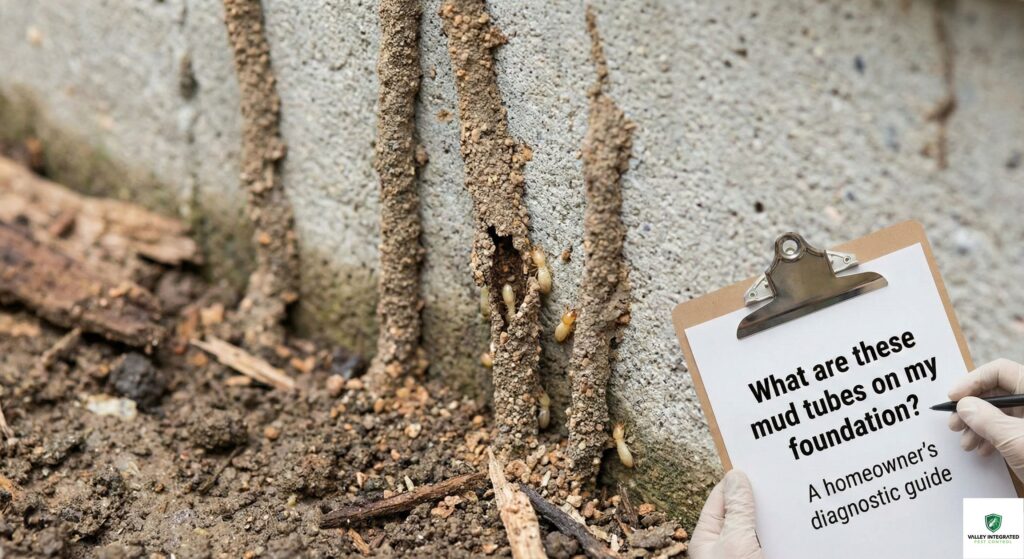
Those pencil-thin mud tubes on your foundation are shelter tubes built by subterranean termites. They serve as protected highways from the termite colony in the soil to the wood in your home. Finding them is a clear sign of termite activity and reveals the exact entry points termites are exploiting.
The Alarming Discovery: More Than Just Mud on Your Walls
Finding unexpected lines of dried mud snaking across your home’s foundation walls can be unsettling. Your mind immediately jumps to one word: termites. These structures, officially known as shelter tubes or termite mud tubes, are one of the most common signs of a termite infestation. They are constructed by worker termites from a mixture of soil, wood particles, feces, and saliva. But before panic sets in, it’s important to understand what you’re really looking at.
These earthen tubes are more than just a symptom of a problem; they are a diagnostic map. They tell a story about how wood-destroying insects are interacting with your property. Subterranean termites, the species responsible for the vast majority of termite damage, live underground in a large termite colony and require constant moisture to survive. Subterranean termites build distinctive ‘mud tubes’ to gain access to food sources and to protect themselves from open air, dehydration, and predators. Think of these termite tunnels not just as an intrusion, but as a blueprint revealing the specific vulnerabilities termites have found in your home’s defenses.
A Symptom vs. a Diagnostic Tool: Shifting Your Perspective
How you view these mud tubes fundamentally changes your approach to solving the problem. Most homeowners see the tubes as the problem itself, but a pest control professional sees them as valuable clues to a much larger issue.
Viewing Tubes as a Symptom
The initial reaction is to see the tube as a direct sign of an infestation that needs to be eliminated immediately. This perspective often leads to a narrow focus: “How do I get rid of this tube?” People might scrape it off, spray it with a store-bought pesticide, and hope for the best. While understandable, this approach only addresses the visible evidence. It does nothing to affect the foraging termites, the termite queen, or the rest of the colony hidden in the soil, and it erases the very evidence a professional would use to diagnose the full extent of the termite activity.
Reading Tubes as a Diagnostic Map
A termite specialist, however, reads these mud tunnels like a roadmap. The location, direction, and type of tube provide critical information. A tube emerging from the soil and running up a concrete slab to the sill plate points to a specific entry point. A network of exploratory tubes spreading out in a crawl space suggests termites are actively searching for new food sources. By analyzing these signs, a professional can pinpoint the exact structural and environmental weaknesses that termites are exploiting to breach your home.
What the Location of a Termite Mud Tube Reveals About Your Home
Every mud tube tells a story. Understanding where they appear is the first step in diagnosing your home’s vulnerabilities and developing an effective termite prevention and termite treatment plan. This is the core of professional pest management.
Tubes on Foundation Walls: The Classic Entry
The most common sight is a working tube running vertically up an exterior foundation wall or basement wall. Termites often build these to bypass the concrete or block and reach the wood structure above, typically the rim joist or floor joists. These tubes almost always originate from a tiny, unseen entry point. Key termite prevention measures include reducing openings that offer termites access, such as filling cracks in cement foundations and around where utilities pass through the wall. Even a hairline foundation crack is wide enough for these persistent pests to enter.
The Invisible Superhighways: Hidden Construction Gaps
Sometimes, mud tubes seem to appear from nowhere inside the house, like emerging from behind a baseboard. This is because termites are master exploiters of hidden construction features. Common invisible entry points include:
- Concrete Expansion Joints: The small gap left between a garage slab and the house foundation is a well-known superhighway for termites to get into walls undetected.
- Plumbing and Utility Penetrations: The areas where pipes and conduits pass through your concrete slab or foundation walls often have small gaps around them, providing a direct, sheltered path from the soil into the subfloor.
- Hollow Block Foundations: Termites can travel upwards inside the voids of concrete blocks, emerging directly into the sill plate with very little visible evidence on the exterior.
The On-Ramp: Landscaping and Moisture Problems
Termites don’t just randomly find your home; certain conditions create a perfect on-ramp, inviting them right to your foundation. Excessive moisture is the number one attractant. Damp wood attracts termites, and preventative designs include keeping the ground around a home dry by sloping the ground and directing water away from the foundation. Common conducive conditions include:
- Wood-to-Soil Contact: Firewood stacked against the house, mulch piled high against the foundation, or wooden deck supports sunk directly into the ground provide a seamless bridge for termites.
- Poor Drainage: Clogged gutters, downspouts that discharge too close to the foundation, and improper grading all lead to saturated soil, creating the ideal moist environment for a termite colony to thrive.
- Leaky Pipes: A slow leak from an outdoor spigot or in a crawl space can create a constant source of moisture, effectively ringing a dinner bell for any nearby foraging termites.
Identifying Termite Tubes and Ruling Out Imposters
Before you can take action, you need to be certain you’re dealing with termites. Several other things can be mistaken for their handiwork.
What Does a Termite Mud Tube Look Like?
Termite shelter tubes are typically about the width of a pencil, but can vary. They are gritty in texture and will crumble easily if broken. Inside, you may see small, creamy-white worker termites. There are a few different types you might see:
- Working Tubes: These are the “highways,” connecting the soil to the wood food source. They are the most commonly found tubes.
- Exploratory Tubes: Thinner and more delicate, these branch out from the main tubes as termites search for new sources of cellulose.
- Drop Tubes: These are less common, extending from the wood structure back down to the soil, like stalactites.
- Swarm Tubes: Built specifically for termite swarmers (alates) to exit the structure during reproductive flights.
What Can Be Mistaken for Termite Mud Tubes?
Not everything that looks like a mud line is from termites. Mud dauber wasps build clumpy, irregular nests that are much harder and smoother. Some species of ants can create tunnels from debris. More often, lines of dirt are simply rain splash-back or evidence of fungal decay on damp wood. The key difference is the structured, tunnel-like appearance of termite tubes compared to the more random or clumpy look of imposters.
Can I Just Scrape Them Off?
You can, but you shouldn’t. Removing an active tube will kill the few termites inside it, but it does nothing to stop the infestation. The main colony, which can contain hundreds of thousands of individuals, remains safe in the soil and will simply build a new tube. More importantly, by removing the tubes, you destroy crucial evidence that a pest control professional would use to determine the infestation’s origin, age, and scope. The best first step is to leave the tubes intact and call for a professional termite inspection.
Key Factors in Your Decision: From Diagnosis to a Permanent Solution
Addressing a termite issue requires a clear-headed approach. Here are the critical factors to consider as you move toward a solution, a process that a good exterminator or pest control firm will walk you through.
Identifying the Root Cause of Entry
This is the most important step. Is the entry point a tiny foundation crack, a gap around a water pipe, or are termites coming up through an expansion joint in the garage? A thorough inspection is needed to find all entry points, not just the most obvious one. Without this, any treatment is a shot in the dark.
Determining the Urgency and Scale of the Infestation
An old, dry, and crumbling mud tube is a different story than a fresh, damp one teeming with worker termites. Are there other infestation signs, like hollow-sounding wood, discarded wings from a recent swarm, or visible wood damage? Some species, like the invasive Formosan subterranean termite, are particularly aggressive. A typical Formosan subterranean termite colony may exceed 1 million insects, and because of their larger colony size, they attack wood at a faster rate than native subterranean termites. Further, discovering winged termites indoors, which are often confused with carpenter ants, almost always indicates an infestation warranting treatment.
Choosing Between a Temporary Fix and a Long-Term Solution
This is the essence of the “Seal and Treat” strategy. A temporary fix, or “spot treatment,” might kill termites in one specific area. A long-term solution, however, is a two-pronged approach. First, it involves a comprehensive professional termite treatment, such as applying a liquid termiticide like Termidor to create a continuous chemical barrier in the soil around your foundation, or strategically installing termite bait stations (like a Sentricon System) to eliminate the entire colony. Second, it involves fixing the underlying structural and environmental issues—the root cause. This includes moisture control, sealing cracks, and removing wood-to-soil contact. This combined strategy is what prevents future invasions and protects your property damage investment.
Deciding on Professional vs. DIY Action
A homeowner can and should tackle the “seal” part of the strategy. Improving drainage, fixing leaks with a dehumidifier in a damp crawl space, and clearing landscaping away from the foundation are vital home maintenance tasks. However, the “treat” portion requires a licensed professional. Applying a termiticide correctly and safely to create an effective soil treatment requires specialized equipment, knowledge of regulations, and access to professional-grade products. For real estate transactions, a formal Wood-Destroying Insect Report (WDI) from a certified inspector is almost always required.
Making the Right Choice for Your Needs
The right path forward depends entirely on your situation and goals. There is no one-size-fits-all answer, but here is some tailored guidance.
For the Panicked Homeowner
You’ve just found a mud tube for the first time, and you’re worried about structural damage. First, take a breath. Significant termite damage cost accumulates over years, not days. Your priority is clarity. Carefully break off a one-inch section of a tube. If you see small, white insects, it’s active. Your immediate next step is to schedule a professional termite inspection. An expert will identify the species, map the infestation, locate the entry points, and provide you with a clear treatment plan and quote.
For the Proactive DIYer
You found a tube during a routine self-inspection. This is a great opportunity to harden your home’s defenses. Use this discovery as your guide. If the tube is near a dripping spigot, fix the leak. If it’s coming up where mulch touches the siding, pull the mulch back. Conduct a full perimeter walk, looking for any other conducive conditions. You can handle the crucial termite prevention work, but for an active infestation, you should partner with a termite specialist for the actual treatment to ensure the colony is eliminated.
For the Real Estate Professional
You’re representing a buyer or seller, and mud tubes are discovered during a showing or home inspection. Time is of the essence, and so is documentation. You need to engage a reputable pest control company to perform a formal WDI inspection immediately. This legally recognized report will detail any active termite activity, evidence of past infestations, visible damage, and all conducive conditions. This document is critical for negotiating repairs, securing a termite bond, and ensuring a smooth, legally sound transaction for all parties.
Ultimately, understanding that a mud tube is a diagnostic clue empowers you to move beyond fear and toward an effective, long-term solution. By addressing both the termites and the vulnerabilities they exploit, you can protect the structural integrity and value of your home for years to come. For homeowners in Fresno, CA, and the surrounding areas seeking a comprehensive assessment and a partner in long-term pest control, Valley Integrated Pest Control provides expert inspections and tailored treatment strategies to protect your most valuable asset. Contact our team of termite specialists today for a professional evaluation and a clear path forward.


