
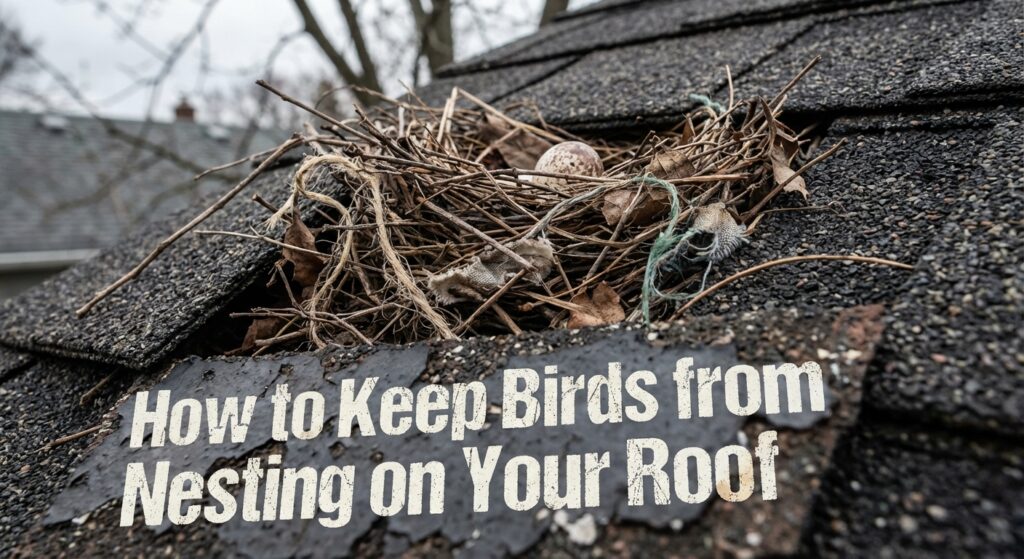
The most effective and responsible way to keep birds from nesting on your roof is to first identify the species. While some birds are pests, others like the Chimney Swift are protected. Acting without identification can lead to legal penalties and fails to address the root cause of the problem.
Why a “One-Size-Fits-All” Approach to Bird Removal Fails
That familiar chirping you hear from your roof might seem harmless at first, but when a pair of birds decides your home is the perfect place to raise a family, the situation can quickly escalate. From clogged gutters and water damage caused by nesting materials to the corrosive effects of bird droppings (guano) on your roof shingles, birds nesting on your house can cause significant structural damage. For many homeowners, the immediate reaction is to look for a quick removal solution.
However, reaching for a generic pest control product or attempting nest removal without a clear strategy is often a mistake. This approach is not only frequently ineffective in the long term, but it can also place you in legal jeopardy. The truth is, the birds on your roof might not be pests at all; they could be protected native species seeking refuge, and your home might be their last resort.
The Crucial First Step: Nuisance Bird or Protected Neighbor?
Before any action is taken, a proper identification is essential. The world of avian visitors is diverse, and your strategy must adapt accordingly. In fact, experts agree that before beginning any control program, you should be able to identify which birds are causing the problem and know something about their behavior and habits, as this determines which control methods to use. This single step separates a successful, long-term bird abatement plan from a frustrating cycle of failed attempts and recurring damage.
Many of the common culprits are indeed considered avian pests. These non-native, invasive species can be managed more directly. The most common nuisance birds you’ll find trying to make a home in your eaves, attic vents, or rafters are:
Pigeons (Rock Doves): Notorious for leaving large amounts of corrosive guano on window ledges, solar panels, and roofing.
House Sparrows: Aggressive birds that build messy nests in small crevices, like roof vents and soffits, often creating a fire hazard with their flammable nesting materials.
European Starlings: Known for gathering in large, noisy flocks and creating significant sanitation issues.
Crucially, the most common nuisance birds—the feral pigeon, house sparrow, and starlings—are not protected under federal laws like the Migratory Bird Treaty Act because they are not native species. This legal distinction gives property owners more flexibility in how they manage these specific populations.
However, many other birds, including some that look similar to pest species, are fully protected. Native species like Barn Swallows and Cliff Swallows often build their mud nests under the eaves or on the sides of buildings. Crows, while intelligent and sometimes loud, are also protected. The most surprising protected guest, however, might be the one you can’t even see.
Case Study: The Chimney Swift, a Secret Ally in Your Chimney
If you hear a chittering sound coming from your fireplace, you may not have bats or a common pest bird. You might be hosting a family of Chimney Swifts. These incredible birds, often described as “cigars with wings,” are in serious decline, partly due to the loss of their traditional habitat: hollow trees. As a result, they have adapted to use masonry chimneys for nesting and roosting.
Far from being a pest, the Chimney Swift is a powerful ally in natural pest control. Chimney swifts dine exclusively on flying insects, eating one-third of their body weight per day. A single family of swifts can consume thousands of mosquitoes, gnats, and termites every day.
Unfortunately for them and us, their populations are dwindling. That’s why the chimney swift is a neotropical migratory bird protected by the Migratory Bird Treaty Act (MBTA), which makes harassing, injuring, or killing swifts, their eggs and their nests illegal. If you have Chimney Swifts, your chimney has become a vital sanctuary for a species in need.
Understanding the Law: The Migratory Bird Treaty Act and Your Responsibilities
The Migratory Bird Treaty Act (MBTA) is a cornerstone of wildlife protection. This federal law makes it illegal to pursue, hunt, take, capture, kill, or sell birds listed as migratory birds. Critically for homeowners, this protection extends to active nests. An “active nest” is generally defined as one containing eggs or young birds. Disturbing, destroying, or moving an active nest of a protected species—even if it’s on your property—can result in significant fines and penalties.
This is where patience becomes a legal and ethical requirement. The solution isn’t to break the law; it’s to work with the birds’ natural cycle. According to wildlife experts, removing nests of protected birds must be timed according to their migration departure; once the birds have migrated and vacated their nests, it is safe to remove them. This allows you to protect your property without harming vulnerable wildlife.
Comparing Bird Management Strategies
When faced with birds nesting on your roof, you have two primary philosophies to choose from. Understanding the pros and cons is key to making a confident decision.
Generic Pest Removal (Immediate Action)
This approach treats all birds as pests and focuses on immediate removal or eradication of nests, often using over-the-counter deterrents or direct intervention. While it seems like a quick fix, it’s fraught with risks. It can easily lead to illegal removal of a protected species’ nest, and temporary deterrents rarely solve the underlying issue, meaning birds often return the next season.
Species-Specific Management (Integrated Approach)
This is the professional standard for wildlife removal services. It begins with identification. If the bird is a non-protected pest like a starling, the focus shifts to humane removal and implementing permanent exclusion solutions. If the bird is a protected species like a swallow or swift, the strategy is to wait until the nesting season is over and the birds have migrated. Then, and only then, are exclusion devices installed to prevent their return to that same spot next year. This method is legal, ethical, and provides a permanent, long-term solution.
Your Roof Protection Toolkit: Answering “What Can I Put on My Roof to Keep Birds Away?”
Once you’ve identified the species and, if necessary, waited for nesting season to end, you can implement a variety of tools to prevent future issues. The most effective strategies focus on exclusion—physically blocking birds from their preferred nesting spots.
Physical Exclusion: The Best Long-Term Defense
Exclusion is about making your home impenetrable. This form of home maintenance is the most permanent way to stop birds from nesting on your roof.
- Chimney Caps: A professionally installed chimney cap is the single best way to prevent Chimney Swifts and other animals from entering your chimney while still allowing for proper ventilation.
- Vent Covers: Placing sturdy wire mesh or specially designed vent covers over roof vents and attic vents prevents House Sparrows and starlings from gaining entry to your attic.
- Gutter Guards: These not only prevent clogged gutters from leaves but also stop birds from building nests in the gutters themselves.
- Structural Repairs: Sealing holes in soffits, fascia boards, and around dormers with wire mesh or sealant eliminates the cozy, protected cavities that many birds seek.
Humane Deterrents: Making Your Roof Uninviting
When exclusion isn’t fully possible or needs to be supplemented, deterrents can make an area less attractive. These are common answers to the question, “what repels birds from nesting?”
- Bird Spikes: These are blunt-tipped strips installed on flat surfaces like window ledges, pergola beams, or rafters to prevent birds from landing. They are a highly effective, humane deterrent for larger birds like pigeons.
- Bird Netting: When installed correctly, netting is one of the most effective ways to block birds from large areas, such as the underside of eaves where cliff swallows nest or commercial loading docks. Professional installation is key to ensure it is effective and doesn’t trap birds.
- Shock Track Systems: These low-profile strips deliver a mild, harmless electric shock when a bird lands, teaching them to avoid the area. They are very effective and discreet for protecting ledges and rooflines.
- Bird Slope Panels: These angled panels are installed on ledges to create a slick surface that birds cannot get a foothold on, forcing them to move elsewhere.
- Sensory Deterrents: Items like reflective tape (scare tape), predator decoys (decoy owls), or ultrasonic bird repellers can have some short-term effect. However, birds are intelligent and often quickly realize these are not a real threat, limiting their long-term effectiveness.
Making the Right Choice for Your Needs
Ultimately, the best strategy depends on your specific situation, property type, and personal priorities. There is no single “best” answer, but there is a right approach for you.
For the Pragmatic Homeowner
Your primary goal is a fast, effective, and permanent solution to the noise and property damage. Your best course of action is to invest in permanent exclusion solutions. Focus on professional installation of high-quality physical deterrents like bird spikes on ledges and shock track systems on roof peaks. Seal all potential entry points with vent covers and wire mesh, and install a chimney cap. This “do it once, do it right” approach provides the best long-term value and peace of mind.
For the Eco-Conscious Resident
You seek a humane and legal solution that respects wildlife. Your first step is always identification. A pair of binoculars and an online bird guide can be invaluable. If you have a protected species, embrace the opportunity to co-exist for the short nesting season. Once they migrate, you can safely clean the area and install humane exclusion devices like netting under the eaves (for swallows) or a cap on the chimney (for swifts) to gently guide them to a new location next year without harm.
For the Commercial Property Manager
You need a legally compliant, discreet, and guaranteed solution to address health codes, liability, and damage to large-scale structures. Legal compliance with the Migratory Bird Treaty Act is paramount to avoid significant penalties. Your only viable option is to engage a professional wildlife removal service for a comprehensive bird abatement plan. This will involve a thorough site assessment, species identification, and the professional installation of large-scale solutions like bird netting, shock track systems, or bird wire systems to protect your investment and ensure public safety.
Navigating the complexities of bird management requires expertise, a respect for wildlife law, and a commitment to long-term solutions. An integrated approach that starts with identification and ends with professional exclusion is the most reliable way to protect your property. For a personalized assessment and a strategy tailored to your specific needs in Fresno, CA and the surrounding areas, contact the expert team at Valley Integrated Pest Control today.


