

To keep mice out of your car engine, you must move beyond temporary repellents and adopt a two-pronged strategy: proactive prevention by sealing entry points and eliminating attractants, combined with a biohazard-safe cleanup protocol. The greatest danger is not the wire damage, but the health risk from viruses like Hantavirus aerosolized during improper cleaning.
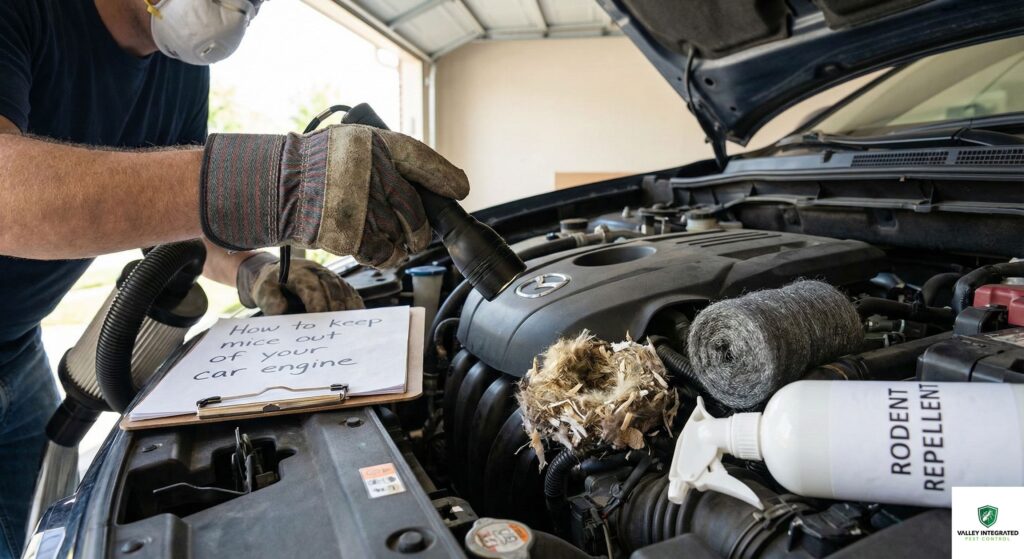
The Unexpected Rattle: Discovering a Rodent in Your Engine Bay
It often starts with a subtle sign. A check engine light that appears without reason, a strange smell coming through the vents, or, most alarmingly, turning the key to complete silence. For many drivers, this is the first indication that uninvited guests have taken up residence under the hood. In fact, drivers often first discover a rodent problem when their car won’t start, a problem frequently caused by mice chewing through wires in the engine compartment.
Your immediate thought likely jumps to the hassle and expense: a tow truck, a visit to the mechanic, and a potentially hefty repair bill. You might pop the hood and find the evidence yourself—a messy nest of shredded insulation tucked near the battery, a scattering of rodent droppings on the engine block, and the tell-tale signs of gnawing on hoses and wires. While the fear of costly electrical damage is valid, it masks a far more serious and often-overlooked danger: the critical health risk lurking within that nest.
Damage vs. Disease: Understanding the Two-Fold Threat of a Rodent Infestation
When a mouse, rat, or even a squirrel decides your engine compartment is the perfect shelter, they create two distinct and serious problems. One is a direct threat to your wallet, and the other is a direct threat to your well-being. Understanding both is the first step toward a truly effective solution.
Costly Mechanical and Wire Damage: The modern vehicle is a complex web of electronics, and to a rodent, it’s an endless buffet. Many manufacturers, including Honda and Toyota, now use soy-based wiring insulation, which is more environmentally friendly but unfortunately also attractive to hungry varmints. They gnaw on critical components not just for food, but to file down their constantly growing incisors. A single mouse can cripple a vehicle’s electrical system, shred vacuum hoses, destroy fuel lines, and build a nest in your air filter box, restricting airflow and performance. The financial consequences are staggering; aside from potential health issues from rodent-borne diseases, a single rodent living under the hood can cause thousands of dollars in damage. This isn’t an exaggeration—in one documented case, a car owner reported a repair quote of ‘well over $2000.00’ after a mouse or squirrel destroyed the engine wire harness and ABS sensors in their vehicle. This kind of damage can lead to an expensive insurance claim and significant downtime without your car.
Critical Biohazard and Health Risks: This is the hidden danger that most people miss. The real threat isn’t just the visible nest; it’s the invisible pathogens it contains. Rodents are vectors for numerous diseases, but one of the most serious associated with their droppings and nests is Hantavirus. According to public health officials, some rodents, such as deer mice, can carry hantavirus, and their nesting materials, droppings, and urine may contain the virus, creating a risk for people cleaning or riding in the car. The virus becomes airborne when disturbed. When you turn on your car’s heat or air conditioning, the ventilation system can pull these aerosolized viral particles from the engine bay, through a contaminated cabin air filter, and blow them directly into the passenger cabin for you and your family to breathe. This transforms your car’s interior into a potential contamination zone, a risk that far outweighs the cost of any mechanical repair.
Your First Instinct Is the Most Dangerous: Why Common Cleanup Methods Fail
Upon finding a disgusting nest in your engine bay, your first instinct is to get it out—immediately. You might reach for a shop vac, a stiff brush, or even a pressure washer to blast the filth away. This is, without question, the most dangerous thing you can do.
Health authorities are clear on this point. You should not use a vacuum cleaner, sweep, or use a high-pressure sprayer on rodent droppings or nests until they have been disinfected, as this can create infectious aerosols. These actions pulverize the dried feces and urine, launching invisible, virus-laden dust particles into the air. A standard vacuum filter is not fine enough to trap these microscopic pathogens; it simply acts as a fan, dispersing them more widely and increasing your risk of inhalation. This is the critical mistake that can lead to severe respiratory illness.
The Professional Decontamination Protocol: A Step-by-Step Safety Guide
So, how do you get rid of mice in your car engine safely? The correct way to handle a rodent infestation in your vehicle mirrors the protocol used by biohazard professionals. It prioritizes neutralizing the pathogens before any physical removal begins. If you choose to undertake this yourself, you must follow these steps without compromise.
- Ventilate and Prepare: Move the vehicle to a well-ventilated, outdoor area—not inside a closed garage. Open the hood, all doors, and the trunk. Let it air out for at least 30 minutes. Before you begin, put on personal protective equipment (PPE), including non-absorbent gloves and, critically, a HEPA-filter-equipped N95 respirator.
- Disconnect the Power: For your safety, disconnect the vehicle’s battery. This will prevent any risk of electrical shock or causing a short circuit in the electrical system while you work.
- Disinfect, Don’t Disperse: Prepare a disinfectant solution. A mixture of one part household bleach to ten parts water is effective. Using a spray bottle, thoroughly saturate the nest, droppings, and any visible urine stains. Do not be shy with the spray; the goal is to completely soak the materials. Let the solution sit for at least 5-10 minutes to give it time to deactivate any viruses.
- Safe Removal and Disposal: Once the materials are thoroughly disinfected, use paper towels to carefully pick up the nest and droppings. Place everything into a heavy-duty plastic bag. Seal the bag tightly, then place it inside a second plastic bag and seal that one as well. Dispose of it according to your local regulations for potentially hazardous waste.
- Sanitize the Engine Bay and Cabin: After removing the bulk of the contamination, spray the entire engine compartment with your disinfectant solution and wipe it down. Pay close attention to the firewall insulation and areas where the nest was located. Finally, and this step is crucial, locate and replace your cabin air filter, as it has likely trapped contaminated particles. Carefully disinfect the housing before installing the new filter.
From Reaction to Prevention: How to Fortify Your Vehicle
Cleaning up the mess is only half the battle. To truly solve the problem, you must shift from a reactive mindset to a proactive one. The goal is to make your vehicle an unattractive, impenetrable fortress for any future rodents seeking shelter, especially during the cold winter months.
Identify and Seal Entry Points
A mouse can squeeze through an opening the size of a dime. Your vehicle, despite seeming solid, has numerous potential entry points. Inspect your car’s firewall for any gaps where wires or cables pass through. Check for holes in the ducting for your car’s air intake, worn-out gaskets, or even rust holes in the body. You can use materials like steel wool or hardware cloth to securely block these gaps. Mice don’t like to chew through metal, making it an effective barrier.
Make Your Vehicle Uninviting
A key way to deter rodents is to manage the environment where you park. If you have a garage, keep it clean and decluttered. Don’t store pet food, birdseed, or garbage cans near your vehicle, as these are powerful food sources. If you park in a driveway, try to keep it away from overgrown bushes, woodpiles, or barns where rodent populations thrive. For vehicles or farm equipment stored for long periods, an easy trick is to simply raise the hood to allow light in and make the engine compartment less attractive as a dark, secure shelter.
Exploring Repellents and Deterrents
The market is full of products claiming to keep rodents at bay. Their effectiveness varies widely, and most should be viewed as one layer in a larger defensive strategy, not a standalone solution.
- Can you spray rodent repellent on a car engine? Yes, there are many commercial rodent repellent spray products, from brands like Tomcat and Grandpa Gus’s, designed for use in engine bays. These often use a combination of predator urine scents and intensely bitter or spicy ingredients. For safety, always apply them to a cool engine and reapply frequently, as their scent fades with heat and time.
- Can I spray peppermint oil on my car engine? Peppermint oil is a popular DIY repellent. While mice dislike the strong scent, its effectiveness is temporary. Soaking cotton balls in peppermint oil and placing them around the engine compartment can help, but they need to be replaced every few days as the oil evaporates. It’s a mild deterrent, not a guaranteed solution.
- Will dryer sheets keep mice out of your car? This is a common piece of folklore. Like peppermint, the theory is that the strong odor of dryer sheets or a bar of Irish Spring soap will deter mice. However, there is no scientific evidence to support this, and rodents have often been found using these items as nesting materials. They are not a reliable way to protect your car.
- Specialized Solutions: For high-value vehicles or after an expensive repair, you might consider more robust options. Some manufacturers, like Honda, offer a special capsaicin-treated electrical tape (often called Honda Rodent Tape) that can be wrapped around a new wiring harness to deter gnawing. Electronic deterrents, such as a rodent strobe light or an ultrasonic pest repeller, can also be installed under the hood, though expert opinions on their real-world effectiveness are mixed.
Trapping and Population Control
If you have an active rodent infestation in your garage or on your property, repellents alone won’t be enough. You need to reduce the local population. A combination of classic Victor snap traps, humane live traps, and strategically placed bait stations can be effective in curbing the number of rodents looking for a warm place to nest.
Making the Right Choice for Your Needs
The decision between a DIY cleanup and calling a professional exterminator depends on your specific situation, resources, and comfort level with the risks involved. There is no single “best” answer, but here is some tailored guidance for different perspectives.
The DIY Mechanic: You’re comfortable under the hood and confident you can repair the chewed wires and replace the damaged hoses. Your primary focus is on fixing the visible damage and getting the car running again. However, your expertise in mechanical repair doesn’t negate the biological risk. The biggest danger is underestimating the health threat and using a shop vac or compressed air to quickly clear the nest, unknowingly contaminating your workspace and yourself. For you, the best path is to rigorously follow the full professional decontamination protocol *before* you even pick up a wrench. Treat the cleanup as a separate, critical biohazard procedure, not just a prelude to the real repair work.
The Health-Conscious Parent: Your primary concern isn’t the repair bill; it’s the unsettling thought of what could be blowing out of your car’s vents and into your children’s lungs. You worry about lingering pathogens and whether a DIY cleanup is truly enough. For you, the peace of mind that comes with professional pest control and biohazard remediation is paramount. A certified technician can ensure that every trace of the infestation is safely removed and sanitized, including hard-to-reach areas like the HVAC system and cabin air filter housing, giving you confidence that your family’s ride is safe and healthy.
The Fleet Manager: You manage multiple cars, trucks, or even a boat or RV fleet, and your concerns are magnified. A rodent problem means costly vehicle downtime, escalating repair costs, and a potential health liability for your employees. An infestation in one vehicle can easily spread to others parked nearby. Your most effective strategy is not to react to individual incidents but to implement a comprehensive, integrated pest management program for your entire garage or parking area. Professional rodent control can establish a defensive perimeter with bait stations and traps, conduct regular inspections, and provide a cost-effective, long-term solution that prevents problems before they start.
Protecting your vehicle from rodents is a two-part challenge: addressing the immediate mechanical and health threats, and establishing a long-term preventative strategy. It requires a clear understanding of the risks and a commitment to solving the problem at its source. At Valley Integrated Pest Control, we understand both sides of this problem. Our certified technicians provide not only safe, thorough biohazard cleanup but also comprehensive strategies to prevent future infestations. If you’re in the Fresno, CA area and need a professional assessment to protect your vehicle and your health, contact us today for a consultation and a free quote.


