

The most common pests that damage clothing fall into two distinct categories. The first are ‘Fiber Feeders,’ like clothes moths and carpet beetles, whose larvae specifically consume animal-based fibers such as wool, silk, and cashmere for a protein called keratin. The second, more surprising group are ‘Stain Eaters,’ including silverfish, cockroaches, and crickets, which damage fabrics incidentally while feeding on invisible food spills, body oils, and starches left on seemingly clean clothes.
The Mystery of the Damaged Wardrobe: More Than Just Moths
It’s a deeply frustrating moment: you pull a favorite wool sweater from storage only to discover a constellation of tiny, mysterious holes. Or maybe you notice the collar on a stored cotton shirt looks frayed and weakened. The immediate suspect for most people is moths. While clothes moths are certainly a major culprit, they are only one part of a much larger story. The real key to protecting your wardrobe isn’t just knowing which insects cause harm to clothes, but understanding *why* they are attracted to your garments in the first place.
The core truth is that fabric-damaging pests operate with two very different motives. Unraveling this mystery is the first step toward effective, long-term control. Some pests are true textile connoisseurs, equipped with the unique biological tools to digest the very fibers of your most prized possessions. Others are simply opportunistic snackers, treating your clothes like a soiled napkin after a meal. By understanding this distinction, you can move from reactive panic to proactive protection.
Meet the Culprits Part 1: The ‘Fiber Feeders’ That Crave Your Finest Garments
This group represents the specialists of the insect world. They are after a specific protein called keratin, the fundamental building block of animal hair, skin, and feathers. In fact, clothes moths and carpet beetles are among the very few insects capable of digesting keratin, which makes your wool, silk, fur, and cashmere garments a primary food source. These are the bugs that eat natural fibers with a purpose.
The Infamous Clothes Moths (Tineola bisselliella & Tinea pellionella)
When people think of bugs eating sweaters, they think of clothes moths. It’s important to note that the small, fluttering adult moths you might see are not the direct cause of the damage; they don’t even have mouthparts to eat with. The real damage is done by their offspring. The two most common types you’ll encounter are the webbing clothes moth and the casemaking clothes moth. The webbing clothes moth larvae spins silk tubes or patches as it moves across the fabric, leaving a messy trail of webbing mixed with droppings (called frass). The casemaking clothes moth larva, by contrast, creates a tiny, portable case from the very fibers it’s eating, carrying its shelter on its back.
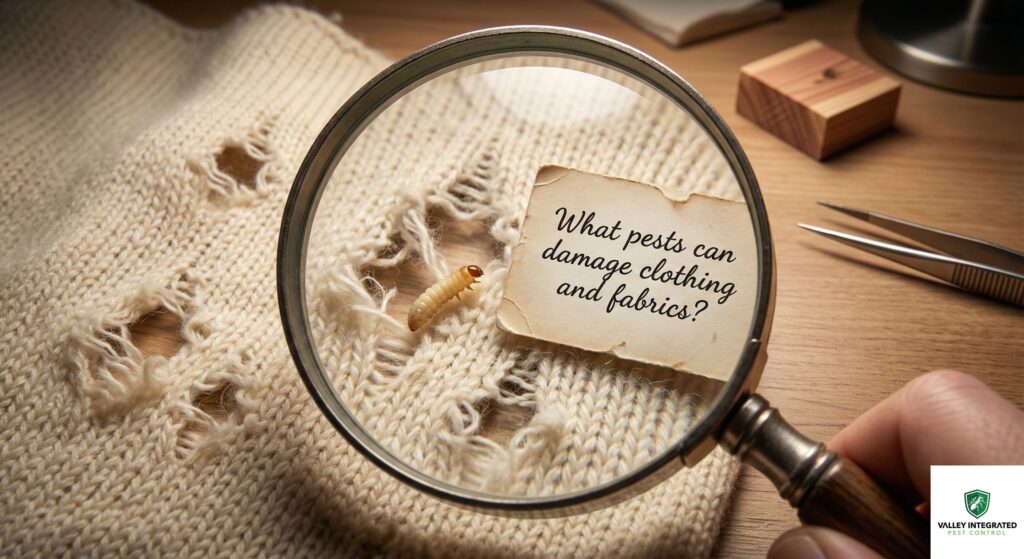
The actual culprits, the clothes moth larvae, are creamy white caterpillars that can be up to 1/2 inch long. These tiny white worms on my clothes are what you need to worry about. They require keratin to develop into adult moths, and to them, your wardrobe is a five-star buffet. According to researchers, these clothes moth larvae (caterpillars) consume items containing keratin, a protein found in animal fibers like cashmere, fur, alpaca, and wool. What does moth damage look like? Typically, you will find irregular, scattered holes. The size of the holes depends on how long the larvae were allowed to feed. You might also find silky webbing or the small, rice-like cases left behind. One female moth can lay up to 500 eggs, making a small problem escalate quickly.
Interestingly, they are even more drawn to these garments when they are soiled. Experts note that moth caterpillars prefer natural fibers that have body oil on them, which acts as a ‘nice salad dressing.’ This makes wearing a sweater even once before storing it a significant risk.
The Stealthy Carpet Beetles (Anthrenus & Attagenus species)
Often overlooked but equally destructive, carpet beetles are another primary keratin feeder. The small adult beetles, often a mottled mix of black, brown, and white, are frequently found near windowsills, as they feed on pollen and are attracted to light. Like moths, the adults don’t damage fabrics. The damage comes from their larvae, which are small, bristly, and carrot-shaped, often referred to as “woolly bears.” One of the most common signs of an infestation is finding shed insect skins in drawers or at the edges of carpets, as the larvae molt multiple times as they grow.
If you need to know how to check for carpet beetles, look in dark, undisturbed areas: under furniture, along baseboards, deep in closets, and in stored blankets. Varied carpet beetle identification can be tricky, but their larvae are quite distinct. The damage they inflict often differs from that of moths. While moth holes can be scattered, carpet beetle vs clothes moth damage often appears as numerous, small, and concentrated holes, sometimes shearing the nap of the fabric clean off in one area. They are notorious bugs that damage wool rugs, often starting from the underside.
A key difference is their diet is much broader than that of clothes moths. Besides keratin, they also feed on dead insects, pet dander, and stored food products like flour and cereal. This versatility poses a dual threat: an infestation can start in your pantry and migrate to your closet. So, are my clothes safe from pantry pests? Not if carpet beetles or larder beetle larvae are involved. They can also be responsible for furniture beetle damage to fabric, living deep within upholstery and feeding on the natural fibers within.
Meet the Culprits Part 2: The ‘Stain Eaters’ Who Treat Your Clothes Like a Dinner Plate
Now we move to the surprising truth behind many cases of fabric damage. What is eating my clothes besides moths and beetles? The answer is often a pest that has no biological need for the fabric itself. These insects are attracted to your clothing for the remnants of your last meal, your sweat, or even the starch in your detergent. The fabric damage is simply a byproduct of their feeding, like an accidental bite out of a paper plate while eating a slice of pizza. This explains the mysterious tiny holes in t-shirts and other plant-based fabrics like cotton and linen.
Silverfish and Firebrats (Lepisma saccharina & Thermobia domestica)
These small, wingless, fast-moving insects thrive in dark, humid environments like basements, bathrooms, and attics. They are drawn to polysaccharides—sugars and starches. As it turns out, your clothes can be covered in these substances. Food stains, beverage spills, body soil, and even glues and starches used in the manufacturing process create an invisible buffet. Research confirms that silverfish eat clothing not for the actual material, but for the nourishing substances (like starches and sugars) often found on the fabric.
Signs of silverfish damage in books and clothes include irregular, scraped, or “shaved” areas on the surface of the material. Sometimes they chew clean through, creating odd-shaped holes. This is a key difference when comparing silverfish holes vs moth holes, which are typically more uniform. You may also notice a faint yellowish stain around the damaged area. Do silverfish eat synthetic fabrics like polyester or rayon? Generally, no, unless those fabrics are heavily soiled with food or sweat that they find appealing.
Cockroaches (Various species)
Yes, roaches can make holes in clothes, and it’s a more common problem than most people realize. Cockroaches are the ultimate opportunistic feeders and are drawn to almost any organic matter. When it comes to clothing, they aren’t seeking the fabric itself. Instead, cockroaches are drawn to bodily sweat, food and drink spills, and starch from cleaning products on clothes; as they eat these substances, they damage the fabric fibers. This feeding action can weaken and sever fibers, leading to holes that may become more apparent after washing. Furthermore, their excrement and secretions can cause significant staining, which is why the question “can cockroaches stain clothes?” is an unfortunate yes.
Crickets (Acheta domesticus)
Crickets, particularly house crickets that find their way indoors, can also be a source of fabric damage. Similar to cockroaches and silverfish, their goal isn’t to consume the textile itself. Do crickets eat clothing? They do, but only under certain conditions. They are most likely to cause damage when the clothing is soiled. According to pest experts, crickets may chew holes in clothing, and are especially attracted to articles soiled with food, perspiration, or grease. Their strong mandibles can cut through fibers, often resulting in larger, ragged holes. This often explains why there are holes in my socks, as they retain a high concentration of sweat and body oils.
Identifying the Intruder: A Guide to Textile Pest Forensics
So, how to tell if bugs are eating your clothes? The key is to become a detective in your own home. By carefully examining the evidence, you can create a reliable textile pest identification guide and determine the most likely culprit, which is the most critical factor in choosing the right prevention method.
Analyzing the Damage: What the Holes Tell You
The type of hole is your first clue. Identifying pests by the holes they leave can narrow down the suspects considerably.
- Small, numerous, often clustered holes: This pattern, especially on wool, cashmere, or silk, strongly suggests carpet beetle larvae damage. They tend to feed in one area, almost like grazing.
- Scattered, irregular holes with webbing: If you see random holes accompanied by silky tunnels or a fine web-like material on the fabric surface, you are almost certainly dealing with webbing clothes moths.
- Clean, small-to-medium holes with no webbing: This could be casemaking clothes moths, but if the material is cotton or a blend, it’s worth considering a stain eater.
- Scraped or shaved surface damage: An area where the surface of the fabric looks abraded, sometimes with a yellow tint, is a classic sign of silverfish or firebrat damage.
- Large, ragged holes with pulled threads: This more aggressive-looking damage is characteristic of crickets or cockroaches, especially on heavily soiled items.
Searching for Evidence: Signs of an Infestation
Beyond the holes, look for direct signs of the pests themselves. This is crucial for a positive ID.
- Live Insects: Finding small brown bugs in closet spaces points toward adult carpet beetles. Seeing small, tan moths that avoid light and flutter weakly are likely clothes moths. Spotting fast-moving, silvery insects in a dresser drawer is a clear sign of silverfish.
- Larvae: The presence of the actual damage-doers is definitive. Check the seams, collars, and cuffs of garments. Finding what look like tiny white worms on your clothes confirms a clothes moth infestation. Discovering small, hairy, caterpillar-like larvae confirms carpet beetles.
- Shed Skins and Casings: As carpet beetle larvae grow, they molt, leaving behind brittle, empty skins. Finding shed insect skins in drawers is one of the most common ways people discover a carpet beetle problem. The small, rice-grain-sized cases of the casemaking clothes moth are also a dead giveaway.
- Frass: This is the technical term for insect droppings. It often looks like fine sand or pepper and will usually be the same color as the fabric the larvae have been eating.
Using Monitoring Tools
For a suspected moth problem, using pheromone traps for clothing moths can be an invaluable diagnostic tool. These sticky traps release a synthetic version of the female moth’s mating pheromone, attracting and capturing male moths. While they won’t solve an infestation (they don’t attract females or larvae), they are extremely effective at confirming the presence of clothes moths in your home and helping you gauge the scale of the problem.
Your First Line of Defense: A Dual-Action Protection Plan
Now that you understand the two primary motives for fabric pests, you can implement a plan that starves out the Stain Eaters and blocks out the Fiber Feeders. This is the cornerstone of integrated pest management for textiles. Your laundry habits and storage solutions are your most powerful weapons.
Action 1: Eliminate the Buffet for ‘Stain Eaters’
This is arguably the most important step because it also makes your clothes less attractive to Fiber Feeders. The single best way to prevent pests from damaging clothes is to ensure they are meticulously clean before they are stored.
- Wash or Dry-Clean Before Storage: Never store clothing that has been worn, even for a few hours. Invisible sweat, skin cells, and microscopic food particles are what pests are attracted to. A garment that looks and smells clean to you can be a feast for an insect.
- Use High Heat: The best way to clean clothes to kill insect eggs and larvae is with heat. Washing clothes at a temperature of at least 132°F (55.6°C) or tumbling them in a hot dryer for 30 minutes will kill all life stages of most common textile pests. This is the best temperature to wash clothes to kill pests.
- Trust Professional Cleaning: Do dry cleaners kill clothes moth eggs? Absolutely. The chemicals used in the dry cleaning process, combined with the high heat of pressing, are lethal to pests. This is an excellent option for delicate items like wool, silk, and cashmere before long-term storage.
Action 2: Create a Fortress Against ‘Fiber Feeders’
Once your clothes are perfectly clean, the next step in pest control for clothing storage is to make them physically inaccessible. This is especially critical for your valuable natural fiber garments.
- Choose Airtight Storage: The gold standard is using pest proof clothing storage bags or, even better, rigid plastic containers with tight-fitting lids. Cardboard boxes are not suitable, as many pests can chew through them. Vacuum-sealed bags are also an excellent option for preventing bug damage to clothes in attic or basement storage.
- Understand Natural Repellents: Many people use cedar blocks for moth prevention or sachets of lavender. What smells repel clothes moths? The aromatic oils in cedar and herbs like lavender, rosemary, and cloves are natural repellents. However, it’s crucial to understand their limitation: they repel, but they do not kill. The oils also dissipate over time, so cedar needs to be lightly sanded every few months to remain effective. They should be seen as a secondary line of defense, not a primary solution for an active infestation.
- Inspect Regularly: At least once a season, open up your stored containers and inspect your garments for any signs of trouble. An early discovery can prevent catastrophic damage.
Advanced Tactics and When to Seek Professional Help
For minor issues or as a preventative measure, several DIY methods can be effective. However, for widespread or persistent problems, professional intervention is often the wisest and most effective choice.
DIY Control Methods
If you’ve identified a localized problem, you may be wondering how to get rid of fabric-eating insects yourself. Here are a few proven tactics:
- Freezing: Will freezing clothes kill moth larvae? Yes, it’s a very effective method for delicate items that cannot be washed in hot water. Seal the item in a plastic bag, squeezing out as much air as possible. Place it in a freezer set to 0°F (-18°C) for at least 72 hours.
- Steam Cleaning: Can steam cleaning kill carpet beetle larvae? Yes. The high-temperature steam is lethal to larvae and eggs. This is a great way to treat carpets, upholstery, and curtains. It’s an important part of how to treat a carpet beetle infestation that has spread beyond the closet.
- Thorough Vacuuming: One of the most critical steps for getting rid of bugs in dresser drawers and closets is a deep clean. Use a crevice tool to vacuum all corners, cracks, and baseboards where dust and larvae can hide. Be sure to dispose of the vacuum bag in an outdoor trash can immediately.
- Diatomaceous Earth: For a low-toxicity approach, food-grade diatomaceous earth for fabric pests can be applied in wall voids, under furniture legs, and in the back of closets (not directly on clothing). It works by abrading the insect’s exoskeleton, causing dehydration.
Why Professional Intervention is Sometimes Necessary
Determining if professional intervention is needed is a key decision. You should strongly consider calling an expert when:
- The infestation is widespread. If you’re finding evidence in multiple rooms, in your carpet, and on your furniture, the problem is likely beyond the scope of DIY treatments.
- Valuable items are at risk. When it comes to protecting vintage clothing from insects or protecting heirloom fabrics from pests, the cost of professional treatment is minimal compared to the cost of losing an irreplaceable item. A professional textile pest treatment can be tailored to the specific materials.
- The source is unclear. Professionals are trained to find the source of an infestation, which could be an old wool rug, a piece of infested furniture, or even a bird’s nest in the attic.
- DIY methods have failed. If you’ve tried cleaning, storing, and treating but the problem persists, it’s time for a more comprehensive approach.
Making the Right Choice for Your Needs
The right strategy for protecting your wardrobe depends on your specific collection of clothing, your lifestyle, and your willingness to engage in preventative measures. Here is some tailored advice for different situations.
For the Fashion Collector
Your primary concern is protecting expensive, natural-fiber garments like wool, silk, and cashmere from the destructive ‘Fiber Feeders.’ Your focus should be on impeccable prevention. Before any period of storage, every item must be professionally dry-cleaned. Invest in high-quality, airtight storage containers—not just bags. Regular inspection of your collection is non-negotiable. For a truly valuable collection, consider annual consultations with a pest management professional to establish a monitoring and preventative treatment plan, creating a protective bubble around your investments.
For the Busy Parent
You are on the front lines against the ‘Stain Eaters.’ With a high volume of everyday clothing, frequent food spills, and piles of laundry, your greatest risks are from opportunistic pests like crickets, cockroaches, and silverfish. Your most effective strategy is routine. Don’t let laundry baskets overflow. Treat food stains immediately. Establish a strict “clean before storing” rule for out-of-season clothes. Use durable, easy-to-seal plastic bins rather than cardboard boxes. The mysterious tiny holes in cotton t-shirts are almost always linked to invisible stains, so a disciplined cleaning regimen is your best defense.
For the DIY Problem-Solver
Your goal is to be a textile detective. You want to accurately identify the specific pest and understand its motive to apply the correct home remedy. Use this guide to analyze the type of holes and search for secondary evidence like casings or shed skins. If you confirm clothes moths, deploy pheromone traps to monitor activity and use the freezing method for affected garments. If you suspect carpet beetles, a thorough, top-to-bottom vacuuming of the entire area is your first step, followed by targeted application of diatomaceous earth in cracks and crevices. Your success hinges on correct identification leading to the right targeted action.
Ultimately, protecting your clothing comes down to understanding the “why” behind the damage. By identifying whether you’re dealing with a pest that wants to eat the fabric or one that wants to eat the stain on the fabric, you can create a far more effective and lasting defense. For a definitive solution tailored to your home and wardrobe, the expert technicians at Valley Integrated Pest Control can help. We go beyond temporary fixes to address the root cause of fabric pest infestations. Contact us today for a comprehensive inspection and a personalized strategy to protect your belongings for the long term.


