



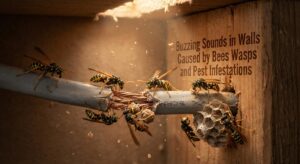
Short answer: if the buzzing stops when you cut the breaker, it’s electrical and you need an electrician today. If it keeps going, it isn’t wiring. A sound that outlives the breaker is either mechanical or it’s insects in the wall cavity, and the timing of the sound tells you which.

You shut off the breaker to that room and stood there waiting for the buzzing to stop. It didn’t.
That’s not a dead end. It’s the most useful thing you’ve found out so far, because a sound that outlives the breaker usually isn’t electrical at all — and often isn’t a fault with the house. Most of what you’ve been reading was written by electricians, which is why it all points one way.
Here’s what the timing of the sound tells you, and how to confirm the most likely cause from your own driveway, without opening a wall.
If the Buzzing Stopped When You Cut the Power
Then this article isn’t for you, and you should stop reading it.
A buzz that switches off with the circuit is electrical. That’s arcing, a loose connection, or a failing component, and yes — it’s a genuine fire risk, not a nuisance. Leave the breaker off and call a licensed electrician. Don’t wait for it to get louder.
Everything below is for the other case: the sound that kept going.
Why Everyone Told You a Buzzing Wall Means Faulty Wiring
Because it usually does, and because the people writing about it are electricians describing the problem they get called out for.
Here’s the part that advice leaves out. Electrical buzzing is tied to the circuit. It needs current to exist, so cutting the current kills the sound. That’s the whole reason the breaker test is worth doing.
So when the buzzing survives the test, it hasn’t failed. It has given you a clear answer: whatever is making that noise isn’t running on the electricity you just switched off. It’s either mechanical — a pump, a fan, an appliance somewhere else in the house — or it’s alive.
One thing to rule out before you go further: make sure you cut the right breaker. Panels are mislabelled all the time, and some homes have a second subpanel. If you’re not certain, throw the main and listen again.
Is the Buzzing Constant, Intermittent, or Only at Night?
This is the question that sorts it, and almost nothing you’ve read will have asked you.
| What the sound does | What it points to |
|---|---|
| Constant, never varies, unaffected by the breaker | Something mechanical — a pool pump, HVAC, a compressor, often on another circuit |
| Builds through the morning, loudest on warm afternoons, fades at dusk | Bees or wasps inside the wall |
| Only after dark, and it starts and stops rather than holding | Rodents — scratching and gnawing, not really a buzz |
That second row is the one people miss. A homeowner on Reddit described hearing “strange intermittent buzzing in the wall to my office for 1–2 hours each morning” — and that daily rhythm is not something wiring does. It’s a colony waking up, warming, and sending foragers out.
Insects follow the weather and the clock. Wiring follows the load. If your buzzing is worse on a hot afternoon and quiet on a cool grey one, you have your answer already.
How to Confirm It’s Insects Without Opening the Wall
Two checks, both free, both doable today.
Knock on the wall and listen. A honey bee colony makes a low, steady hum — thousands of workers fanning their wings to ventilate the nest. Rap the wall and the hum surges, then settles. Beekeepers locate colonies this way, tapping along a wall and listening for the sound to rise.
Go outside at midday and watch one spot. This is the one that settles it. Stand where you can see the outside face of that wall and watch for a few minutes. If there’s a nest in there, you’ll see steady two-way traffic — insects going in and out of a single gap, a vent, a crack in the trim, a gap under the siding. Not one or two wandering past. A stream, always to the same point.
Also look at the inside wall for a damp patch. Established colonies soften drywall with water to enlarge the cavity, and occasionally open a hole straight through it. Yellowjackets do much the same thing, digging out material to make room. A wet patch doesn’t tell you which insect. It tells you something in there is expanding.
What Not to Do Next
Three things make this much worse, and all three are the obvious move.
Don’t spray into the wall. Aerosols for wasp nests are built for a visible nest with a reachable entrance. Fired into a cavity the spray rarely reaches the nest, and wasps attack when they sense poison coming in. Agitated wasps turn up well away from the entry point, sometimes a day later.
Don’t seal the entrance. This is the most common instinct and the worst one. Sealed-in insects hunt for another way out, and the way out is often into your living room — bees will move toward a lamp at night and be at your window by morning.
Don’t kill bees and leave the comb. An established colony can hold up to 100 pounds of honey. Kill the bees and leave it, and the honey ferments and runs down inside the wall until it reaches a window frame or ceiling and soaks through. A pest problem turns into a drywall problem.
What to Do Today
Go outside at midday and watch that wall for five minutes. If you see traffic going in and out of one spot, you have insects in a cavity, and you’ll want it opened and cleared properly rather than sprayed and sealed.
If you’re in Fresno or the surrounding Central Valley, we’ll come out and tell you what’s in there. Walkthroughs are free and there’s no contract to sign. Call (559) 307-0612.


